

That's Nice, Dear
On learning to stop shrinking your own excitement, and why the habit might be costing you more than your feelings

Last week, my mom had a procedure on her back, so I drove her to the appointment and spent the day making sure she was feeling okay. That afternoon, a package arrived. I didn’t think much of it, figuring it was a Kickstarter reward I’d backed.
Surprise! It was the proof copy of Self-Editing for Comic Book Writers.
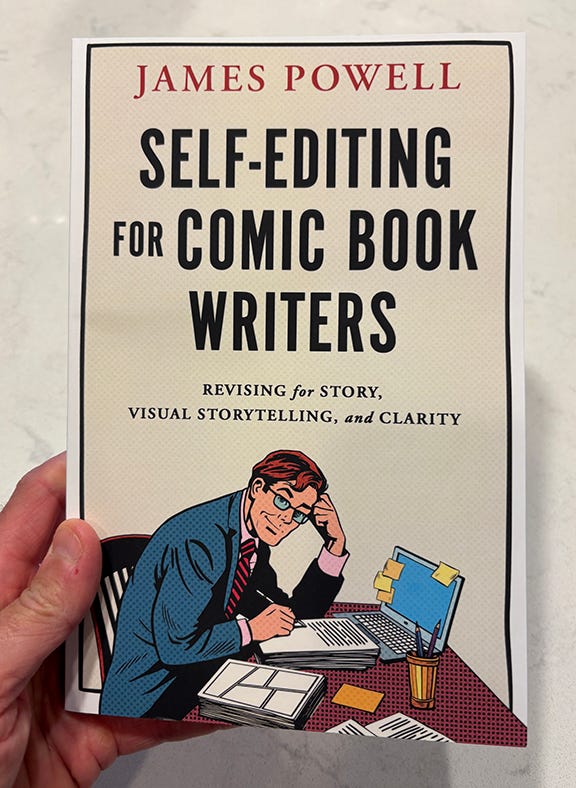
IngramSpark didn’t send any notifications, so I was caught off guard. After the oh, wow, look what came already feeling faded, it slowly became, hey, that looks pretty great.
I felt excitement building. You know, the feeling in your chest when you recognize something you’ve been working on for years is finally seeing the light of day.
Smiling, I turned the book over, studied the back, the spine, and then flipped through the pages. Wow, this looks even better than I—
“What did you get?” my mom asked.
I felt myself shrink. My smile disappeared. So did that sense of excitement and pride.
I pulled in on myself, wanting to hide, and I knew why even as it happened.
I’m genuinely proud of what I built, and I can’t wait to share it with the world.
I just didn’t want to deal with what I knew was coming.
Growing up, the most I ever got from my mom about anything I made was “that’s nice, dear.” Art shown at local banks and restaurants. Straight A’s. Nothing moved the needle.
Years later, I gave copies of a Christmas story I’d written (art paid for out of my own pocket, the piece that eventually became Santa’s Dark Legacy) to my mom, my brothers, my sister.
“Hey, that’s cool” was the best I got.
Without a word, my mom set hers on the table next to her chair. She never looked at it. Never mentioned it again.
Friends weren’t much better. When Dark Horse told me they wanted to publish House of Fear, I organized a happy hour specifically to share the news with friends.
When I told a friend about the publishing deal, another cut in, “Oh yeah? I know someone who writes books.” He then spent five minutes on a woman who’d self-published her third novel. Turns out, my friend met her once. On a random bus ride.
Another friend, more directly: “Don’t get excited, dude. It’s just a comic.”
Don’t get excited. I’ve heard some version of that my whole life, in every context. Even running my first marathon, when the only comment I got from a friend was “Why would anyone do that? Running is stupid.”
So I learned. It’s safer to curb my enthusiasm. To carry that energy alone. To not mention what I’m working on. Best case, people nod and change the subject. Worst case, they tell you that what you did wasn’t big enough to feel good about.
So I shrink.
I hide.
It’s safer that way.
It took me a long time to recognize, but that reflex doesn’t stay in the living room.
It’s the same shrink that turns “hey everyone, I finished my novel and I’m so excited to share it” into something small like, “just wanted to share I made a small thing.”
It’s the same hand pulling you back before you hit publish on a newsletter, before you tell your readers about your latest success, before you let a Kickstarter launch sound like something worth celebrating instead of something you’re sorry for bringing up.
If you’ve spent years being told, directly or by omission, to curb it.
You start editing your enthusiasm the way you’d edit a manuscript, cutting the parts that seem like too much. It becomes a habit standing in for judgment.
I don’t think most of the people in my flashbacks meant to do that to me. My mom, especially. The longer I’ve watched her, the more I think she’s just deeply emotionally unavailable, not withholding on purpose. Probably true of some of my friends too, in their own ways; I just don’t have the same years of evidence to know exactly what’s underneath it for them.
You have to work to find the evidence that it’s okay to celebrate, but it’s there. I’ve gotten better at looking for it. And once you start looking, you find it’s been there more often than you thought.
Which brings me back to the proof copy.
I felt the old pull, and I set the book down, saying, “Oh, it’s just a book I wrote.”
Then I changed course. I recognized the old me and quietly thought, fuck that guy.
I picked it up again and said, “Actually, I’m really proud of this.”
“What’s it about?” she asked. “Another of your stories?”
“No. It’s about editing. I spent almost two years on it. Took everything I’ve learned editing fiction and put it in a book that’s going to help a lot of people.”
“That’s nice.” Same words as always. But this time she added, “Can I read it?”
Small thing. First time in decades it’s happened. I told her she probably didn’t want to read a book about editing, but sure, I’d get her a copy. Then she told me how proud she is of my nephew’s new job.
I’m not fixed. Things aren’t suddenly right. Old patterns don’t dissolve because one moment goes differently. But I noticed the moment, and I shared my truth instead of swallowing it.
Since then, beta readers have sent things like this is fantastic and I swear you wrote this specifically for me.
People online have said they can’t wait to read it. I’m finding an audience because I’m sharing my news. I’m not hiding.
None of that happens if I keep handing my excitement over to people who’ve told me, one way or another, not to have any.
So if you catch yourself downplaying your own work before anyone else gets the chance, check whose voice that actually is. It’s probably just someone from a long time ago, still sitting in the room, waiting to say that’s nice, dear.
You don’t have to keep listening.
Damn, James. This one hit home.
I recently met someone at a public library for a kid's event. We got to talking and he asked me what I did for a living. I said "I write comic books." He said "What comic books do you write?" and as he did he was pulling out his phone, as if to look them up. I said "Well I write indie comic books that I publish through Kickstarter." I listed a couple of my titles. The look on his face changed, and he put his phone away, without looking anything up. Then he changed the subject.
It's hard to remain excited to talk about your achievements with people outside the bubble of actual readers of our stuff, because they consistently think so little of it. If I was writing Batman? Oh that would be cool. But an indie comic book series I poured ten years of my life into, that resonates at the same frequency as my existence because I've given everything I am to it? That's nice.
Woof.
This resonates so much. My Mum’s response to anything I did was, “What do you want to do that for?” She never read anything I wrote, never saw any play or concert I performed in, and didn’t come to my university graduation ceremonies. I see that sense of not being worthy enough playing out all the time, not so much in the work itself, but in my creative and other relationships. It’s not an easy thing to fix, so I’ve learned to manage it as best I can.